
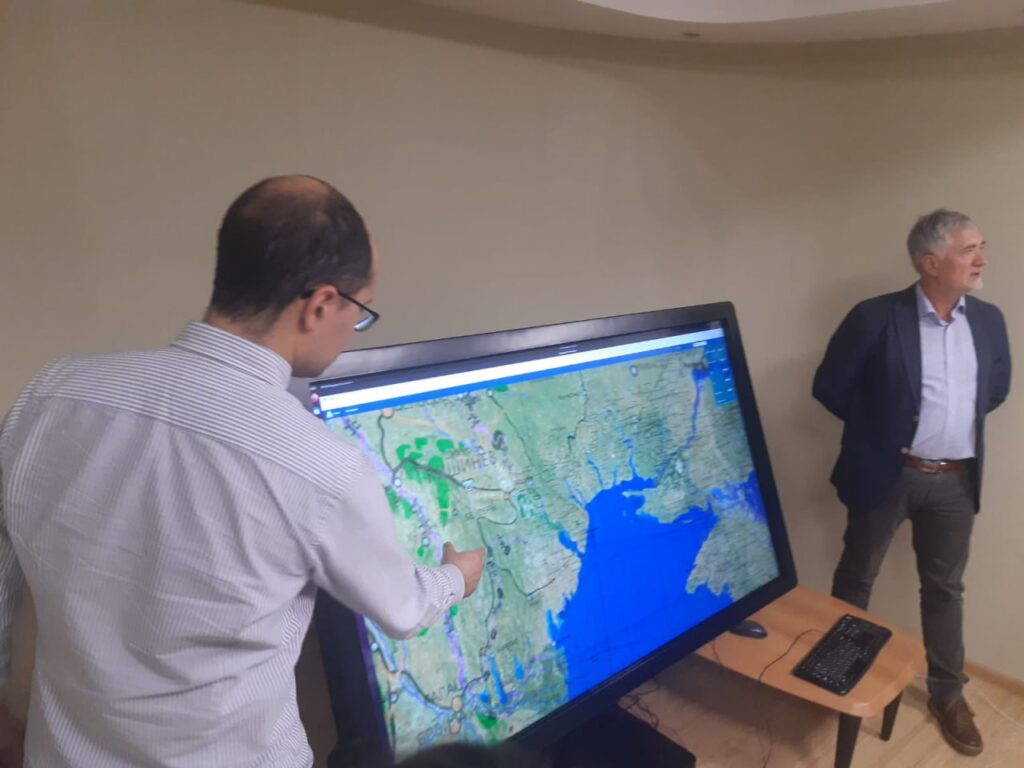
On 28 January 2025, a seminar on «Artificial Intelligence and Intelligent Systems. Development Prospects» was held.
Following the presentations and discussion, the following conclusions were made:
- Intelligent systems already play an exceptionally important role in modern society. However, it is necessary to understand the essence of the methods and libraries used so as not to introduce artificial chaos into real systems.
- An analysis of experience in applying artificial intelligence in serial equipment of the JSC should be conducted. This experience will make it possible to more successfully develop the topic of AI deployment in prospective products.
- The key AI technology is an ontology system. Classifiers and dictionaries should be replaced with modern means of describing subject domains and harmonizing the exchange of information and knowledge between information systems.
- Operational oceanography is an important direction for maritime navigation. However, previous work in this area does not appear to have been very successful. Focusing efforts on developing physical-mathematical ocean models is unjustifiably expensive and requires very careful and detailed operational support with accurate data. Applying AI methods can solve the problem of reducing ocean model development time and maintaining their adequacy and relevance.
- Implementing a scenario system in products such as “Aqueduct” demonstrated a number of advantages of this approach, namely:
- visual representation of tactical and operational tasks;
- scenario adjustment by officers without involving programmers;
- a sharp reduction in development and maintenance time and cost for such systems.
- Applying AI, in particular the SVD method, makes it possible to develop powerful intelligent systems for robots of various scales, from miniature to large, under conditions of limited processor and memory resources. This enables the use of robots where external navigation is unavailable, without heavy inertial navigation systems.
- The scenario-based approach opens new opportunities for underwater acoustics and marine radar.
- The “Aqueduct” system demonstrated the capabilities of mobile compact systems. Similar systems should be widely deployed to solve various maritime navigation tasks.